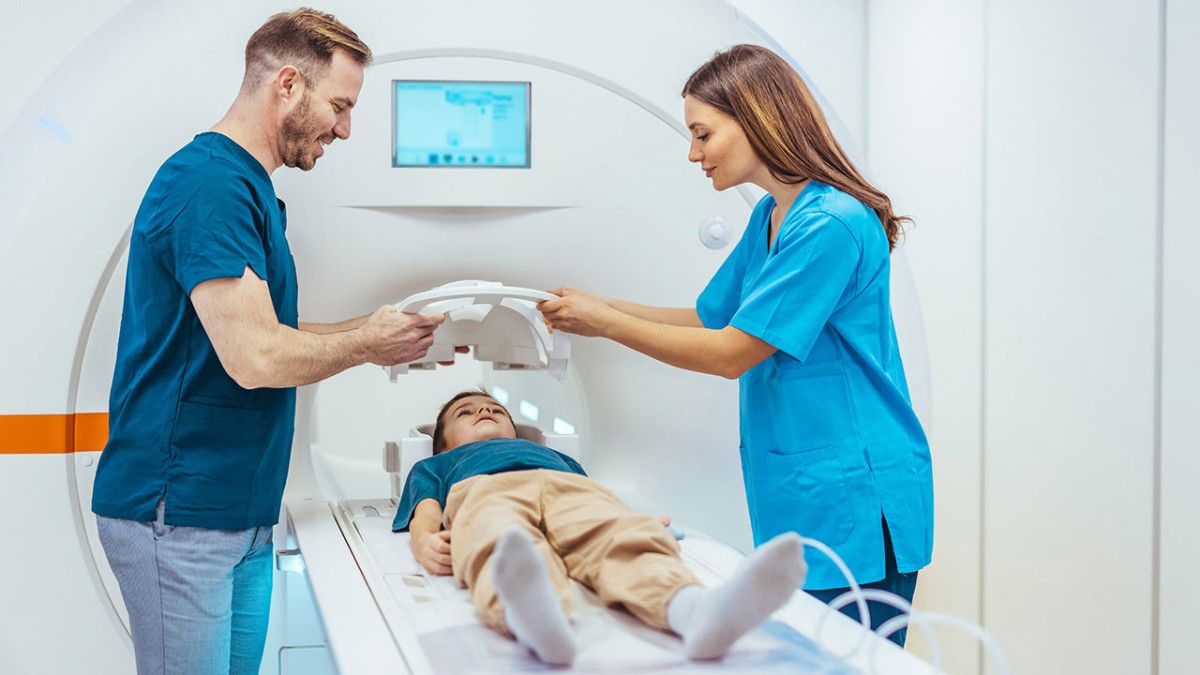
If you’ve ever had an MRI, you may remember lying very still in a large, tube-like machine. But what about the person who helped you get situated and took the images during the scan? That’s an MRI technologist, and their role involves preparing patients for exams, operating scanners, and capturing detailed images of the human body.
If you’re interested in this healthcare career, you may have other questions about what an MRI tech does. In this article, we’ll go over what you should know about this role, including an MRI tech’s responsibilities, where they work, and how to become one.
What Is an MRI Tech?
An MRI technologist, commonly called an MRI tech, is a medical imaging professional who specializes in magnetic resonance imaging (MRI). They use MRI technology to take images of patients’ internal organs, tissue, bones, blood vessels, and muscles.
Unlike X-rays, MRI scanners don’t use ionizing radiation.This technology uses a magnetic field and radio waves to produce diagnostic images. MRI technologists know how to use this equipment safely, and the images they take can help doctors diagnose patients and create treatment plans.
What Are an MRI Tech’s Responsibilities?
MRI technologists spend time with patients, operate complex equipment, and collaborate with physicians. While their role can vary based on where they work, MRI techs commonly have these duties:
- Review doctors’ orders to confirm which parts of the body to scan
- Ask questions about patients’ medical histories and screening concerns
- Explain the MRI process so patients know what to expect
- Position patients correctly for MRI exams
- Operate the MRI scanner and take images
- Administer dyes and other contrast agents when needed
- Check the images for quality and share them with doctors
- Document the exam and update patient records
What’s a Typical Day Like as an MRI Technologist?
An MRI technologist’s day-to-day life can look different depending on the patients they’re scanning. One day, they might perform a knee scan for an athlete. The next day, they may take images for an older patient who has severe back pain.
At the start of a shift, an MRI technologist may review their schedule for the day, check exam orders, and get updates from other technologists. They may also start by preparing exam rooms or checking equipment.
Once they start doing scans, MRI technologists walk patients through the exams, answer any questions they may have, and screen them for potential safety concerns, such as metal implants. From there, technologists operate the MRI equipment, monitor patients throughout exams, check the images for quality, and give them to doctors for review.
MRI technologists often work with patients who feel nervous, scared, or even claustrophobic. They use empathy and communication skills to make those patients feel more comfortable during exams. Technologists also spend much of their days collaborating with healthcare team members, including physicians and other techs.
Where Do MRI Technologists Work?
MRI technologists work in healthcare facilities where patients need diagnostic images. Many MRI techs work in hospitals, but they can also work in diagnostic labs, doctor’s offices, and outpatient centers.
An MRI tech’s schedule can vary based on their employer. For example, a technologist at an outpatient imaging center may have a standard Monday–Friday schedule, while a technologist at a hospital may work evenings or weekends as needed.
How to Become an MRI Technologist
Curious about what it takes to become an MRI tech? Here’s how the process generally works:
1. Earn a Degree
Completing an MRI technology program can help you learn the skills needed to operate MRI scanners and capture diagnostic images. MRI technologists usually need an associate degree, which takes about 2 years to complete. Some programs may take less time. At American Career College, the MRI Technologist program can be completed in as few as 20 months.
MRI technology programs can vary by school, but many teach the same fundamentals. During your program, you can expect to take classes like these:
- Anatomy and Physiology
- MRI Procedures
- MRI Applications and Safety
- Medical Ethics
- Patient Care
- Pathology
- Pharmacology and Administration
These subjects can help you learn about the human body, imaging procedures, patient care, and safety protocols.
2. Gain Hands-On Experience
As you learn new clinical skills in the classroom, you’ll also have the chance to put them into practice. MRI technology programs include clinical experience to help you become comfortable with handling equipment, positioning patients, performing scans, and evaluating images for clarity.
During your clinicals, you’ll work under supervision in real-world healthcare settings. Your program will have a set number of clinical hours you need to complete. This hands-on experience is an essential part of training to become an MRI technologist.
3. Get a Certification
Depending on your state, you may need to be licensed or certified to work as an MRI technologist. Even if your state doesn’t require certification, some employers may prefer you to have this designation. It can help prove your knowledge of diagnostic imaging and patient care.
Many technologists earn the MRI certification through the American Registry of Radiologic Technologists (ARRT). To earn this certification, you must have an associate degree or higher in MRI technology from an ARRT-approved program. You’ll also need to pass a certifying exam and meet an ethics requirement.
Start Your Journey into MRI Technology at American Career College
MRI technologists have many responsibilities, from preparing patients for exams to operating complex equipment to updating patient records. Their days rarely look the same, since they can work with patients who have a range of medical needs. This role requires education, training, and hands-on experience to provide the best patient care possible and help doctors make accurate diagnoses.
If you’re interested in training for this career, American Career College offers an MRI Technologist program designed to help you build clinical and medical imaging skills. This blended program, offered through our Orange County campus, helps prepare students to take the MRI certification exam through the ARRT. In as few as 20 months, you can earn an associate degree in MRI technology and begin your career in this field!
Ready to get started? Reach out today to learn more about ACC’s MRI Technologist program.